
Description
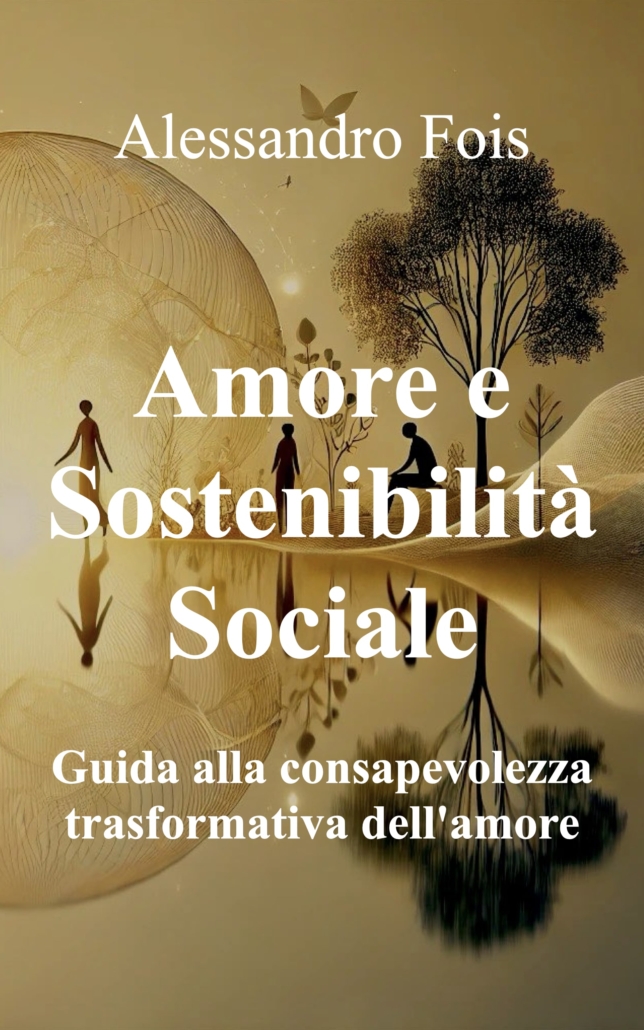
Alessandro Fois
Love and Social Sustainability
A guide to the transformative awareness of love
A guide that explores how Love, understood not only as a feeling but as an ethical principle and transformative force, can become the foundation for creating a more equitable, resilient and sustainable society. In a world where sustainability is often reduced to economic and environmental issues, this book broadens the perspective, focusing on the value of social consciousness and global interconnectedness.
Through deep reflection on the pillars of Truth, Freedom and Justice, the reader is invited to rediscover universal Love as an engine of social cohesion and sustainable development.
The pages offer not only food for thought, but also concrete practices to build a future based on collective responsibility and actions rooted in awareness.
The book is an invitation to undertake an inner and concrete change, where Love becomes the driving force to face the challenges of our time: from social equity to environmental protection to the need for a new global consciousness. With an ethical, spiritual and philosophical approach, the text guides us towards an integrated vision of sustainability that goes beyond mere material parameters.
This book is a call to action, to create a future based on authentic relationships, supportive communities and a deep respect for the balance between human beings and nature. Love is the energy that can radically transform our world and lead it towards a new paradigm of sustainability and justice.
Index
Introductory Message
Editorial note
Index
1 Love as the foundation of global sustainability
The Truth
Freedom
Justice
The Role of Consciousness
Definitions and Contrasts of Conscious Consciousness
Elevation of Consciousness
Negative consciousness: assertion of power
Oblivious consciousness: good and evil according to circumstance
Embryonic consciousness: the good for conformism
Imperfect consciousness: the good for partial integrity
Perfect consciousness: the good by conscious choice
Consciousness and morality: a comparison with Kohlberg's theory
Towards the pinnacle of awareness
Obstacles to Awareness Development
Assertion of one's control
Greed
Prejudice
Unconscious conformity
Conscious conformity
Respect and Bigotry
Pride
Fear of change
Guilt and regret
Envy
Conclusion
Unsustainability of Evil
Evil as a Destructive Force
The Contrast between Evil and Good: Sustainability and Choice
Integrated awareness
2 The Evolution of Consciousness
Technological and conscientious evolution
The impact of technological acceleration
Convergence of Technology and Awareness
Necessary balance between technological and conscientious growth
Ineluctability of the evolutionary process
Historical and natural necessity
The future of humanity
Towards a New Era of Consciousness and Sustainability
3 Critical Analysis of Sustainability Models
Economic and social models
Capitalist-liberalist model
Keynesian model
Communist model
Currency as an obstacle to sustainability
Financial Speculation and Sustainability
Contrast with Sustainability
Sustainability in the founding charters
The Italian Constitution
The Universal Declaration of Human Rights
Challenges to the Realisation of Principles
Conclusion
Religions as Models of Sustainability
Christianity and Universal Love
Love as Guiding Principle
The Agape
Love and Sustainability
Compassion
Forgiveness and Equality
Concrete Love
Historical and Contemporary Impact of Christianity
Christianity's Responsibility in Sustainability
The Concept of 'Next' and Responsibility
Universal love and sustainability in other religions
Non-religious philosophies and sustainability
Humanism
Utilitarianism
Stoicism
Deep Ecology
Critical Theory
Conclusion
4 Solutions for Love-Based Sustainability
Practices to guide the consciousness towards love
Meditation as fertile ground for awareness
Ethical reflection
Immediate self-observation
Gratitude practice
Service to others
Personal growth, study and sharing values
Towards a new paradigm
Premises for Community Life
Dynamics of informal self-regulating communities
Management of essential facilities in collective communities
Interaction and sharing of infrastructure and experience
Theories of sustainability and social cohesion
Sustainable Community Theorists
Social Bonding Theorists
The social glue: an integrated vision
Social Bonding and the Principle of Sustainability
Transition to new sustainable communities
The Fear-based Evil System
Irreversibility of the Elevation of Consciousness Process
Building Sustainable Communities
Concrete Actions and Physical Detachment
Conscious Use of Technology
Reducing Consumption and Enhancing the Essential
Inter-community integration and centralised infrastructure
Allocation of Competencies
Decentralisation from Cities to Villages
Building an Autonomous and Resilient Society
Reconciliation with Nature and Circular Economy
Participatory Governance and Community Culture
Love and Consciousness as the Foundation of Cohesion
5 Conclusion
An Invitation to Transformation


Reviews
There are no reviews yet.